 Greetings!
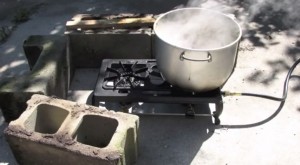
Today we are going to talk about how to render the wax you’re harvesting from your Gold Star Top Bar Hives — some of the cleanest wax you can get. Here’s a picture of the rig that we use to heat the water and melt the wax. It’s a camp stove powered by a propane tank that you can’t see - it’s off to the right. This is a pot that we can’t use for anything else — it’s dedicated to this purpose. Wax is pretty messy, so be sure you’ve chosen a pot that you don’t want to make spaghetti sauce in next week! Our pot is about one third of the way full with water in this photo.
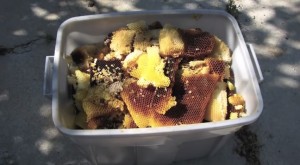 Here’s a Rubbermaid tub full of beeswax. That a fairly big accumulation of wax. You’ll see what it boils down to in the end.
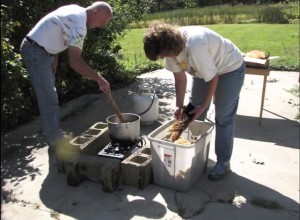 Here we are putting the wax into the water. We are using an old stick to stir with. The cement blocks that you see surrounding the camp stove are just there for a wind break. It’s not a requirement unless it’s windy where you are. (Also in this pic you can see the propane tank.)
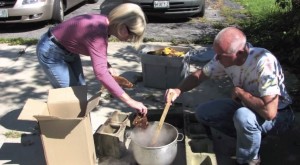 Thanks to Ray and Judy who came to help. They’re putting wax in the pot, stirring it up with the stir stick. You can fill the pot just about two thirds of the way full this way. You don’t want to go too much fuller because it will splash over.
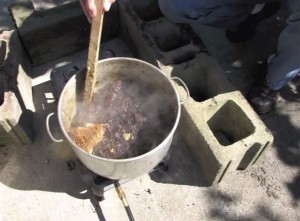
So there’s a bunch of wax that was put in, and it’s melting down. You can see here that there’s a piece that hasn’t melted yet. The brown material you see is actually the cocoons that baby bees spin around themselves as they prepare to pupate inside the cell. So when you’re melting the wax, that material comes loose and floats to the top. It looks a little bit like small brown quartz crystals. We call it slum gum. So you you stir until all the wax is melted and all the slum gum stuff floats up to the top (20-30 minutes).
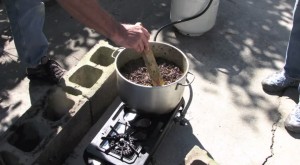
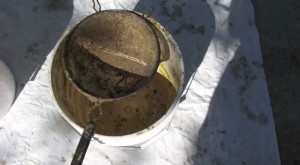 Next you’re going to pour it through a strainer. Again, this is equipment that you’ll never use again for anything else, because it will never be the same again. This is an old kitchen strainer, very coarse, and a five gallon bucket. We are going to pour all of that hot wax with the slum gum through the strainer.
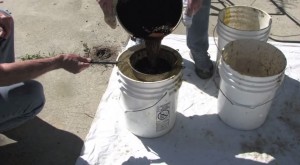 Be very careful doing this!!! Melted beeswax is very hot and you can get burnt pretty badly if you spill this on yourself. Here it is going through the strainer with a helping hand to hold the strainer in place. VERY CAREFULLY pour the entire contents of the pot through the strainer, into the five gallon bucket.
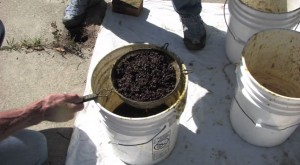
So here it is all poured. That’s a bunch of yuck in the strainer that you’re not going to want (except you could, if you wanted, save it to use as a fire starter — it’s loaded with beeswax and will start a fire pretty quick). Essentially what you’ve done here is the first rendering of your wax. The brown stuff in the bottom of the bucket is wax and water, and the stuff in the strainer is the stuff you were happy to strain out.
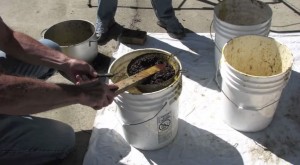 We use that same stir stick from earlier to squish it and get more of the liquid to come out.
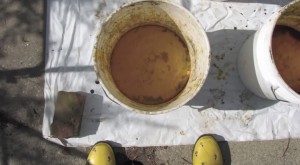 Now one of the neat things about wax is that, as it cools and hardens, it floats. That means that bucket full of brown liquid that you saw a second ago now looks this when that wax has had time to cool and to harden up. It floats up to the top and makes a disk. The best way to get it out is to run a thin knife blade around the edges of the bucket, then you push down on one side of that disk and grab the other side of it, which has popped up to where you can reach it now.
Be sure that you’ve let it cool completely before removing it.
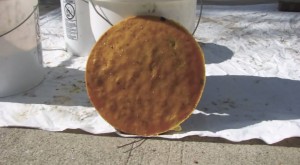 So there you go. We did just what we said: We let it harden, loosened it with a knife, pushed down on one side, grabbed the other edge, and lifted it out of there. That’s about a pound of beeswax.
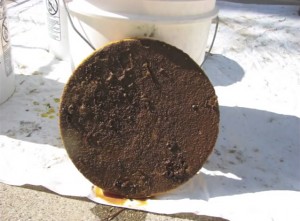 And this is what it looks like on the backside. We wanted to get through that coarse strainer without having to stand there and wait and wait for the wax to drain, so there are still fine particles that floated up underneath the wax, and that’s what you see here. We didn’t use a strainer fine enough to remove this debris in the first rendering. A lot of this fine debris you just scrape off with a spatula or other utensil with a firm edge - but it also means that, depending upon your intended use of the wax - it may require a second rendering. The second rendering we do by taking alternating layers of cheesecloth and putting them in that strainer, melting the wax down in water again, and pouring it through the strainer again.
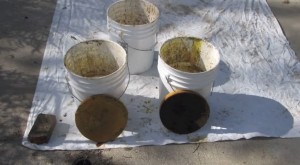 So there are two disks, approximately one pound apiece. The one on the left shows the topside, the one on the right shows the bottom side. Again - please be sure that you use equipment that you have designated specifically for wax rendering because it will never be the same afterwards!
And there you have it, some of the cleanest wax in the whole wide world, straight out of your Gold Star Top Bar Hive. We hope you have a lot of fun doing this. We also hope you are very careful because beeswax is flammable.
Thanks for listening!