On Being A Good Wax Shepherd…
Or, Why You Need To Do A Thorough Bar By Bar Inspection Of Your Top Bar Hive.
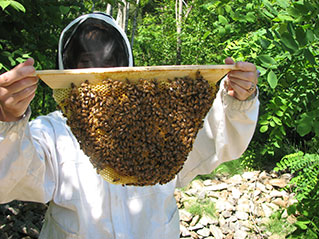 Top bar hives, right or wrong, are considered a “natural” beehive. And it’s true, top bar hives allow the bees to make their own natural beeswax comb. Making their own comb lets the bees make a more natural cell size since they are not forced to use wax foundation with embossed hexagons preprinted on the wax; and the combs are made in the natural catenary curve shape that bees make when they are not constrained by rectangular frames; and natural beeswax honeycomb, made by bees, for bees is the primary reason that I advocate for top bar hives – although, to be fair (and accurate), you can keep bees in a Langstroth hive without foundation as well, it’s just that Langstroth boxes are so much heavier to lift than single top bars.
But somehow the idea of “natural” got tied up with the idea of “leave-em-alone” beekeeping, and here is where we’ve run into trouble. We have asked the bees to come and live in this artificial box that us humans have made (whatever kind of box it is that we have chosen) and there’s really very little that is natural about asking them to do that. So perhaps we need to shoulder some responsibility for making sure that what is going on inside that box is what needs to happen.
One important aspect of beekeeping today is that it is, of necessity, “managed” beekeeping. If natural beekeeping is our focus, we should really look to “manage” in the most “natural” way possible. But that is not the same thing as bonking your bees, pouring them into the hive and then going away and “leaving them alone” until August. It just doesn’t work that way.
Neither does the idea of removing the shutter from the window, glancing at the visible edges of some comb, and saying, “Oh, they look good.” There are only two things you can tell by looking through the observation window in your Gold Star hive, or any top bar hive, and they are:
- The feeder is full/empty – so you should leave it alone/refill it; and
- The bees have/have not built comb on all the bars in their space – so you do/do not need to add more bars.
This kind of inspecting does not constitute actual beekeeping – this is only what we call “bee-peeking.”
So what am I leading up to here? Well, I’d like to coin a new term – the Triple B inspection. What that means is that you need to regularly inspect your top bar hive “Bar By Bar.” You need to remove and look at each and every bar of comb in your hive, thoroughly, in detail. This is the only way you are going to gather all the information that you need to understand the status of your hive and your bees. It is also the only way you can perform your biggest responsibility as a new top bar beekeeper – and that is shepherding your bees’ comb building. There are plenty of sayings concerning the building of wax by bees – and the one that should alarm you the most, early in the season, with a brand new top bar hive, is this: “A wax problem never gets better – it only gets worse.” Your bees, should they get off to a bad start by cross combing, (building comb diagonally across multiple bars) will not suddenly just “figure it out” and start building comb straight on the top bars. Each successive piece of comb will echo the shape of the one before it – it has too, remember? The bees build their comb “bee-space” apart, and so the original “anchor bar” sets the stage for the entire rest of the hive. If the bees choose to ignore your comb guide, and they may, because sometimes “bees do as bees please,” then you can quickly find yourself with a hive that you are unable to inspect at all, and quickly, in this case, can mean less than a week.
The primary requirement of managed beekeeping is the maintenance of “movable comb” – comb that you can remove from the hive and inspect for disease and other issues. A bad case of cross-combing can make your hive a “fixed comb” hive – which was essentially declared illegal in the beekeeping world when many beekeepers’ fixed comb hives were wiped out in the early 1900’s by a huge American Foul Brood epidemic.
So it’s important that you be a good wax shepherd, especially in the very beginning while your bees are filling your brand new top bar hive with their beautiful natural comb, and it’s important to do thorough Triple B inspections, examining your hive bar by bar so that you are supporting your bees in the best way possible, and not just leaving them alone in their wooden box, and calling that natural.
And one more thing about inspecting… I am more than willing, when time permits, to talk with top bar beekeepers about what is going on inside their hives. However – if you haven’t done a bar by bar inspection within a day or two of asking me to perform some “arm chair diagnostics” on your hive – then we probably won’t have enough information for me to ask pertinent questions, and I can’t really help you. And while I love to be helpful – it’s not fair for you to usurp time from others who are doing responsible, thorough Triple B inspections and doing their best to manage their bees in a way that is both natural and responsible*.
So please… inspect. Learn to do it quickly, calmly, thoroughly, and regularly. Correct any cross-combing issues you encounter immediately.
Don’t let “natural” become “irresponsible.” It’s important – for the bees, and for us.
*Stay tuned for upcoming Live Q&A Video-Cons with author Christy Hemenway, founder of Gold Star Honeybees. For more information Join our Email Newsletter here.
Hi,
I built a top bar hive last year and captured a swarm when they brought bee’s in for the cranberry bogs behind my house.They were doing great for awhile building cone, brood and honey.Then around the end of august beginning of September they pretty much just disappeared, there were a few stragglers for awhile. I inspected them regularly (every 7 to 10 days )and was told by friends that I was bothering them to much and they left.So my question is I have about 7 or 8 bars of cone built in my hive already.most of it is straight but there are a couple of curved cones in there.Should I take out what I think might cause me trouble down the road or can it be trimmed? Before I try again
Thanks in advance Mike
Hmmm. That’s called absconding - when they all disappear at once. By August they are unlikely to abscond, so it’s hard to say why they did that.
Re: wax comb - Use all the straight stuff - it’s worth its weight in gold! Curved isn’t necessarily a problem, as long as you can remove it from the hive to inspect it without damage.
Also – Please know that we are running a Kickstarter Campaign – to help us raise the funds needed to get our Top Bar Beekeeping 101 class online – you can check it out here: https://www.kickstarter.com/projects/456838353/plan-bee-top-bar-beekeeping-101-how-to-school-on-v
We appreciate your pledges and we will love it if you share – we’ve got a ways to go to the goal and only 10 more days to do it in!
- Christy
Your personal understanding and kindness in dealing with the subject was excellent!
Great post. I learn something interesting from different blogs everyday. Thanks for sharing!