



Starting bees in a top bar hive
|
Download your free copy of the Gold Star Hive Start-Up Handbook here (.pdf format)
There are two good ways to start bees in top bar hives: 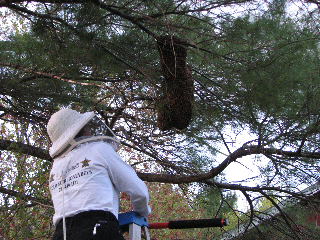 1) With a swarm. The beautiful thing about a swarm is that swarming is the natural reproduction process of honeybees. That means that the bees in a swarm are a finely tuned, well organized "colony". The bees are the right ages for the tasks they will be performing in their new home when it is found, and they are all related to each other, and they are all related to their queen. This is about as close to natural as you could ask for - if you are willing to ignore the rude experience they had when they were knocked off the branch of a tree and carried off by a beekeeper, to be introduced into a man-made beehive. 1) With a swarm. The beautiful thing about a swarm is that swarming is the natural reproduction process of honeybees. That means that the bees in a swarm are a finely tuned, well organized "colony". The bees are the right ages for the tasks they will be performing in their new home when it is found, and they are all related to each other, and they are all related to their queen. This is about as close to natural as you could ask for - if you are willing to ignore the rude experience they had when they were knocked off the branch of a tree and carried off by a beekeeper, to be introduced into a man-made beehive. A swarm's ability to build wax and fill your top bar hive with honeycomb is just amazing! The difficulty with starting your hive with a swarm is that you cannot predict its arrival time - or even if a swarm will come your way at all.  2) With a package. A package of bees has not had the best time of it just before they come to live in your beehive. They are bees of random ages, tumbled together with bees from many other hives in an apiary - they are unrelated, disorganized, and expected to get on with an artificially raised queen that they have never met before. This is a bit further from natural than one could ask for. It does however, have the advantage of being something you can "order", with an expectation as to an approximate arrival date. It's an artificial process and not so good for bees, but they seem to be able to adapt and overcome, and organize themselves into a colony and go forward. We are sold out of package bees for 2011. So - with those options before you - you'll need to make some choices. Swarm or Package? Download your free copy of the Gold Star Hive Start-Up Handbook here (.pdf format) Meanwhile, let's talk about nucs. Just what is a nuc? A nuc is the nickname given to a "nucleus colony". It works like this - you buy a nuc, which is tiny little starter hive of bees - you take it home, and you remove five frames from your Langstroth hive, and you replace them with five frames and the accompanying bees, from the nuc. Voila - instant beehive. If you are using Langstroth equipment, this works beautifully... because it comes on Langstroth equipment! But sometimes novice beekeepers don't realize that a conventional "nuc" isn't going to fit in a top bar hive. And they may not be quite sure what questions to even ask, so the company they are purchasing from doesn't even know how to keep them from making this error and buying bees that won't fit in their top bar hive. Here's a video we did that talks about the differences between package bees and nucs... Primarily, it's a question of non-compatible, non-interchangeable equipment. Top Bar Hives, with their natural wax, are not shaped anything like Langstroth hives. Yes, there are tales of brave (or crazy?) beekeepers who cut apart the frames of a conventional nuc in order to make it fit into a top bar hive - we call that a "hack and slash" job. But we encourage you not to do that - it's hard on you and it's very hard on the bees. And since you're here looking at a top bar hive manufacturer's website - you know that beekeeping is best when it's good for the bees. And easy for the beekeeper. So obviously chopping up a nuc is not the best choice for populating your top bar hive. Make sense? We thought it would. Thanks for listening! |